






-150x150.jpg)







The smart home landscape is evolving at an unprecedented pace. What seemed like science fiction just a few years ago has become everyday reality. As we navigate through 2026, five major trends are reshaping how we live, work, and interact with our living spaces. These aren't distant possibilities—they're happening right now, and understanding them is crucial for anyone considering smart home investments this year.
AI That Actually Predicts Your Needs
Artificial intelligence in smart homes has graduated from responding to commands to genuinely anticipating requirements. The latest systems don't just execute your instructions—they learn patterns so thoroughly that they begin acting on your behalf before you even realize you need something.
This shift from reactive to predictive automation represents the most significant evolution in smart home technology this decade. Modern AI systems analyze hundreds of data points: your schedule, weather patterns, energy prices, occupancy, time of day, day of week, seasonal variations, and even external factors like local events and traffic conditions.
What This Means Practically
Your home now understands that when you arrive home 30 minutes earlier than usual on Wednesdays, it's because you have a standing video call at 5 PM. It pre-adjusts your home office temperature, ensures optimal lighting, and even reminds you five minutes before the call starts.
When the system detects you typically sleep poorly after particularly stressful days (identified through late-night activity and higher thermostat adjustments), it automatically adjusts evening lighting to warmer tones earlier, reduces stimulating notifications, and creates a more relaxing environment conducive to better sleep.
? Key Insight
The newest AI systems learn not just from your explicit actions but from subtle behavioral cues. They recognize when you're stressed, tired, focused, or relaxed—and adjust your environment accordingly without being asked.
? Best Implementation: NexSmart AI Engine
NexSmart's latest AI update processes over 10,000 data points hourly to build remarkably accurate predictive models. Users report the system becomes genuinely helpful within just two weeks of installation.
Matter Protocol: True Universal Compatibility

For years, smart home adoption was hampered by fragmentation—devices from different manufacturers often refused to work together, forcing consumers into proprietary ecosystems. The Matter protocol, which gained widespread adoption in 2024-2025, has finally solved this fundamental problem in 2026.
Matter enables genuine interoperability. A smart bulb from one company, a thermostat from another, and a hub from a third can now communicate seamlessly. This breakthrough has removed one of the biggest barriers to smart home adoption and accelerated innovation across the industry.
Industry Impact
Over 500 certified Matter products launched in 2025 alone, with that number expected to double in 2026. Major manufacturers including Apple, Google, Amazon, Samsung, and dozens of others have committed to the standard, ensuring long-term viability.
What Matter Enables:
- Choose devices based on features and price, not ecosystem compatibility
- Mix and match products from different manufacturers without issues
- Future-proof your investment as new Matter devices automatically integrate
- Simplified setup—devices configure themselves across platforms
- Enhanced security through standardized protocols and regular updates
? Technical Advantage
Matter operates over Thread and Wi-Fi, providing both the low-power benefits of mesh networking and the high-bandwidth capabilities of Wi-Fi. This hybrid approach delivers optimal performance for different device types.
? Best Implementation: Lifesmart Hub 3.0
Lifesmart's latest hub offers full Matter support while maintaining backward compatibility with Zigbee and Z-Wave devices, making it ideal for users transitioning to the new standard without abandoning existing investments.
Energy Intelligence and Sustainability
With climate concerns intensifying and energy costs fluctuating dramatically, 2026's smart homes are increasingly focused on sustainability and energy optimization. Advanced systems now manage entire-home energy consumption with unprecedented sophistication.

Modern energy management extends beyond simple scheduling. AI-powered systems predict energy needs, automatically shift high-consumption tasks to off-peak hours, integrate with solar panels and battery storage, and even participate in grid demand-response programs that can earn credits from utilities.
Integrated Solar and Storage
Smart homes with solar installations now optimize self-consumption intelligently. Rather than simply using solar power when available, advanced systems predict generation based on weather forecasts and coordinate energy-intensive activities accordingly.
Battery storage systems charge during periods of excess solar generation or low-cost grid periods, then discharge during peak pricing. This optimization can reduce electricity bills by 60-80% while supporting grid stability.
Electric Vehicle Integration
As EV adoption accelerates, smart homes are becoming charging hubs. Intelligent charging systems coordinate with home energy management, scheduling charging during optimal periods and even using vehicle batteries as temporary home power storage during outages or peak pricing periods.
? Environmental Impact
Studies show comprehensively automated homes reduce energy consumption by 35-50% compared to traditional homes, with CO2 reductions equivalent to planting 30-50 trees annually per household.
Health and Wellness Monitoring
Smart homes are evolving beyond convenience and efficiency to actively support occupant health and wellness. Environmental sensors now monitor air quality, humidity, temperature, noise levels, and even volatile organic compounds (VOCs), automatically adjusting conditions to optimize health outcomes.

Circadian Lighting
Advanced lighting systems now adjust color temperature throughout the day to support natural circadian rhythms. Morning light includes energizing blue wavelengths, while evening lighting shifts to warmer tones that don't suppress melatonin production, promoting better sleep.
Research demonstrates circadian-aligned lighting improves sleep quality by 20-30%, increases daytime alertness, and can even help alleviate seasonal affective disorder symptoms.
Air Quality Management
Indoor air quality significantly impacts health, yet remains invisible without sensors. Modern smart homes continuously monitor particulate matter, CO2 levels, humidity, and VOCs, automatically activating ventilation, air purifiers, or alerting you to problems requiring attention.
Health Features Now Standard:
- Continuous air quality monitoring with automatic remediation
- Circadian lighting that adapts throughout the day
- Humidity control for optimal respiratory health
- Noise monitoring and sound masking for better sleep
- Temperature optimization for sleep quality
- Integration with wearable health devices for personalized environments
? Health Benefits
Comprehensive environmental monitoring and automated optimization can reduce respiratory issues by 40%, improve sleep quality by 25%, and decrease stress-related symptoms according to recent health studies.
? Best Implementation: Lifesmart Air Quality Suite
Lifesmart's comprehensive air monitoring system includes particulate sensors, CO2 monitors, and VOC detection, all coordinated with ventilation and purification systems for automatic air quality optimization.
Advanced Security with Privacy Focus
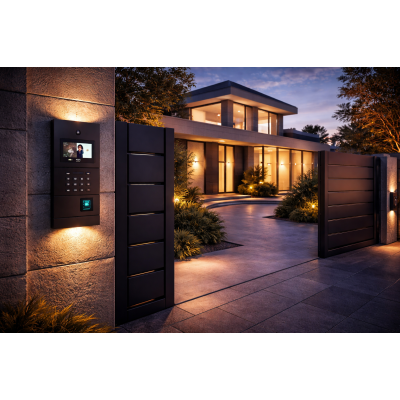
Security remains a primary smart home motivator, but 2026 has brought sophisticated advancements balancing protection with privacy. Modern systems leverage AI for threat detection while processing sensitive data locally to maintain privacy.

AI-Powered Threat Detection
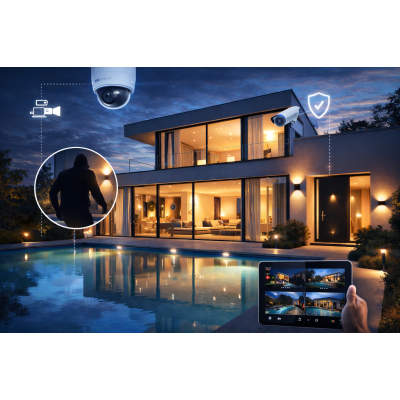
Latest security cameras don't just record—they understand what they're seeing. Advanced computer vision distinguishes between family members, expected visitors, delivery personnel, and potential threats. Package detection alerts you immediately when deliveries arrive, while loitering detection identifies suspicious behavior before it escalates.
Facial recognition has become accurate enough for reliable identification while false positives have dropped dramatically. The technology now handles varying lighting conditions, partial obstructions, and aging gracefully.
Privacy-First Architecture
Growing privacy concerns have driven architectural changes in how smart security operates. Edge computing enables cameras to process footage locally—your face data never leaves your property unless you explicitly enable cloud features.
This hybrid approach provides the privacy of local processing with the convenience of cloud access when desired. Many systems now offer fully local operation modes for maximum privacy with no compromise in intelligent features.
Integrated Response Systems
Security systems now coordinate comprehensive responses to threats. Detecting an attempted break-in doesn't just trigger an alarm—it can activate all exterior lights, begin recording from all cameras, lock all smart locks, send alerts with live footage to your phone, and even alert neighbors through integrated community security networks.
? Security Advantage
Homes with comprehensive smart security systems experience 60% fewer break-in attempts and 85% faster police response times when incidents occur, according to recent security industry data.
? Best Implementation: Hikvision AcuSense Series
Hikvision's AcuSense cameras feature exceptional AI accuracy with full local processing capabilities. Their deep learning algorithms provide industry-leading threat detection while maintaining complete privacy.
Bringing It All Together
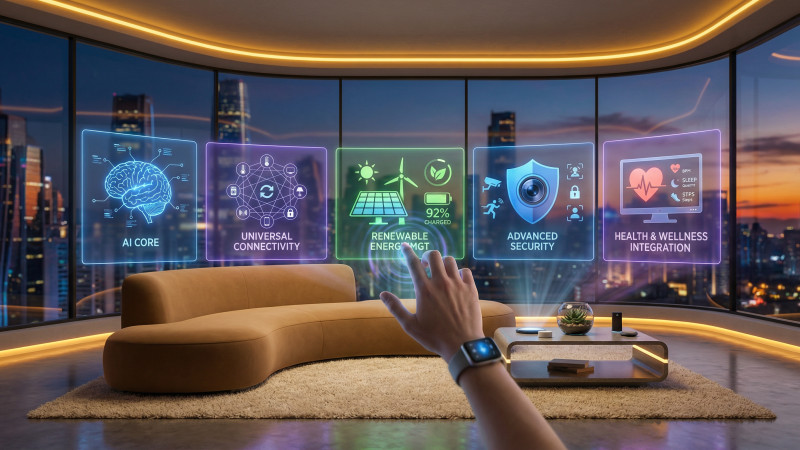
These five trends aren't isolated developments—they're converging to create smart homes that are genuinely intelligent, sustainable, healthy, secure, and respectful of privacy. The technology has matured beyond early adoption phase complications into reliable, user-friendly systems that deliver measurable value.
For anyone considering smart home investments in 2026, understanding these trends is essential. They represent not just current capabilities but the foundation for continued advancement. Systems incorporating these technologies will remain relevant and valuable for years to come, while those ignoring these trends risk rapid obsolescence.
The smart home revolution is no longer about futuristic possibilities—it's about practical implementations improving daily life right now. And with the convergence of AI, universal compatibility, energy intelligence, health optimization, and advanced security, 2026 represents the ideal time to embrace smart home technology.